Tuesday, June 7, 2011

Banh Xeo (Vietnamese Sizzling Crepe)


I love eating banh xeo. I love its deliciously crunchy texture and tasty fresh fillings. 


Banh xeo is a Vietnamese savoury crepe made out of rice flour, water, coconut milk, mung beans and turmeric powder which gives the crepe a vibrant yellow colour (not all recipes add mung beans to the batter but I like to add them in to add an extra dimension of flavour and it also contributes to the colour).

Banh xeo derives its name from the sizzling sound created when the batter hits the frying pan of hot oil. They are stuffed with pork, shrimp, mung beans, bean sprouts and pan fried until crispy. It is served with lettuce, cucumber and fresh herbs, and dipped in some nuco cham.  It encompasses all those elements that people find attractive about Vietnamese food – it’s fragrant, packs with flavour, colourful and uses lots of fresh ingredients.


Ingredients


• peanut oil


For Batter (enough for 6-8 crepes depending on how much batter is used for each crepe and size of frying pan)


• 1 cup rice flour
• 1 ½ cup coconut milk
• ~ ½ cup water
• ½ teaspoon ground turmeric
• ½ teaspoon sugar
• 1 teaspoon salt
• ¾ cup yellow mung beans (cooked) 


For Filling


• 1 thinly sliced onion
• ~ 1 cup yellow mung beans (cooked)
• ~200g thinly sliced pork belly
• ~ 20 prawns 
• ~ 400-500g bean sprouts
• Seasoning for pork and prawns – crushed garlic, fish sauce, salt and pepper


Garnishes


• lettuce
• mint leaves
• thinly sliced cucumber
• grated or julienne carrot


Method


Prep mung beans


Prep 1 cup of dried mung beans, quantity will double when cooked!


In a bowl, wash mung beans thoroughly and soak for at least 3-4 hours before cooking.


Drain, and place mung beans in a saucepan, cover with water and bring to boil, then lower heat and cook mung beans for 15-20 minutes until the mung beans are soft and tender.


Drain well and set aside.


Prep Meat


Pork belly


In a bowl, combine the pork with a splash of fish sauce, some crushed garlic, salt and pepper. Cover and refrigerate for 30 minutes.


Fry pork until cooked/lightly browned and set aside.


Prawns


Leave the shell of the prawns and remove the heads and gut. In a bowl, marinate with a splash of fish sauce, some crushed garlic, salt and pepper. Cover and refrigerate for 1 hour.


Lightly fry prawns with shell on until cooked, let cool, then remove the shells and set aside.


NB: I left the prawn shells on so that the prawns would remain tender and not overcook. Alternatively, can use small shrimp without shell and marinate for 30 minutes, then lightly fry till pink.


Prep Batter


Place ¾ cup of cooked mung beans in a blender and pulse a few times, then add in coconut milk and process to a fine puree.


In a bowl, combine dry ingredients together – rice flour, sugar, salt and turmeric. 


Whisk in mung bean/coconut mixture into the dry ingredients to make a thick batter, then slowly beat in enough water to make a thin crepe batter. 


(The batter should be quite thin and runny.)


Set aside batter mixture for 30 minutes to rest.


NB: Mixed batter can be kept in the fridge for 2-3 days.


Making the Crepe


Peanut oil is spread over a large frying pan and heated well.


Lightly fry sliced onions in pan.


Spoon one ladle full of batter into pan – one hand is used to pour the mixture in fast, while the other hand is used to swirl/revolve the pan quickly to spread the batter around the pan evenly and coat the bottom.


Then scatter cooked mung beans onto the batter.


Add pork, prawns and bean sprouts onto one half of the crepe.


Cook the crepe for around 3-4 minutes. As soon as the edges turn crispy with a yellow/golden brown colour, the crepe is ready to be served. 


Fold the crepe in half and slide onto a warm plate. 


(Can keep cooked banh xeo warm in the over at around 100C, while finishing the rest of the crepes)


Serve crepe with dipping sauce – Nuoc Cham.


Banh Xeo can be eaten on its own or pieces can be broken off and wrapped in lettuce with herbs.


To make nuoc cham – combine ¼ cup of fish sauce, ¼ cup rice vinegar, 2 tablespoons sugar and ½ cup of water in a small saucepan and cook on a low heat, continually stirring until the sugar dissolves and just before boiling point is reached. Set aside to cool. Stir in 2 tablespoons of freshly squeezed lime juice. Then add in 2 cloves of crushed garlic, 1 finely chopped small red chilli and some grated carrot.

Thursday, June 2, 2011

Raw Decadent Desserts Cooking Class by A Foodly Affair


Take away treats from the Raw Decadent Desserts Cooking Class


So the truth is that sometimes a certain animosity can be exhibited by foodies towards vegetarians - they are considered second class citizens. If vegetarians are considered second class citizens, then raw foodists would be third class citizens. Most could not imagine a life consisting of only raw food. But I think that people shouldn’t be so quick to shut down raw foodists and denigrate them to the lower ranks of society, after all, it would be a great survival tactic. Now that winter is upon us, there are increasing possibilities of black outs occurring when storms disrupt power lines, and what if an apocalypse happens as we are continually reminded of everyday that the world is coming to an end sooner rather than later. Shouldn’t a part of Survival 101 include how to cook food with little heating or no heating at all but still get the required nutrients to stay alive? I think so… So as a part of my training on how to survive in an apocalypse and also out of curiosity I signed up to a raw dessert cooking class run by A Foodly Affair on the premises of the much loved Perth café Mrs S in Maylands on a cold and raining Tuesday night a few weeks ago on the 17th of May. 


Hannah runs uncooked cooking classes in Perth. Hannah told us that she became raw last year. After the birth of her son, she became unwell and developed an unknown skin condition that could not be diagnosed by any of the doctors she consulted. She decided to try changing her diet and when she started eating raw food she found herself getting better, so she became 100% raw for a while and is now just 75% raw (you can read more about Hannah's raw food journey on her website - A Foodly Affair). One thing that one can be wary of when dealing with raw foodists or vegetarians is that they can be a bit fanatical over their chosen diet. Whilst Hannah has chosen to go raw as a part of her lifestyle for health and well-being reasons, she states up front that it’s not for everyone. She even acknowledges that some raw foodists can be fanatical, especially over the fact that she was not 100% raw and being raw can be anti-social. Not many places provide raw food options and with the consumption of food being a social activity, most of the time it can be hard to eat out or eat over at a friend’s place.  It was good to see that Hannah was very open minded, she was not here to convert anyone but just to simply educate people about raw food and its benefits, and show that some delicious foods can be made. Contrary to popular belief, raw food is not tasteless or boring or mean that you have to eat like a rabbit.


We started the class by making Hannah’s favourite green juice to drink to refresh ourselves and provide a bit of an energy boost before we got down and dirty into making some decadent desserts. 


(Green juice = combination of lemon, apples, celery, kale, mint, ginger and honey – blended together and strained)


Next on the list was a blueberry cheesecake which was cheeseless for one thing as it contained no dairy, but the other interesting thing was that the blueberries were paired with some rosemary which was put into the base. Blueberries and rosemary make a surprisingly good combination.


(Blueberry cheesecake with a filling of raw cashews, blueberries, dates, lemon, vanilla, agave syrup and coconut oil/butter, and a base made up of almond meal, hazelnuts, rosemary and coconut)


The cheesecake tasted delicious but unfortunately due to time constraints it didn’t have enough time to set in the fridge, so that when we all tried a piece at the end of the class it had more of a mousse like texture. The blueberry cheesecake was served with a dollop of chocolate avocado mousse.


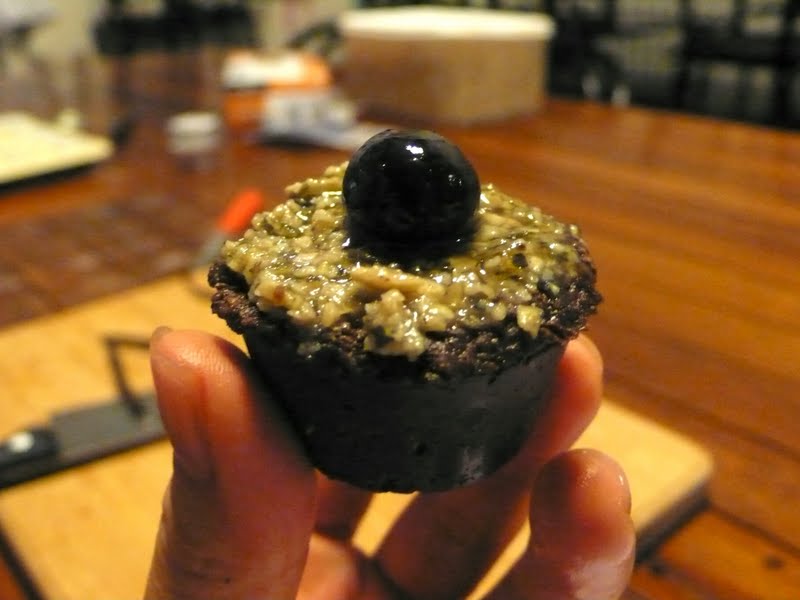
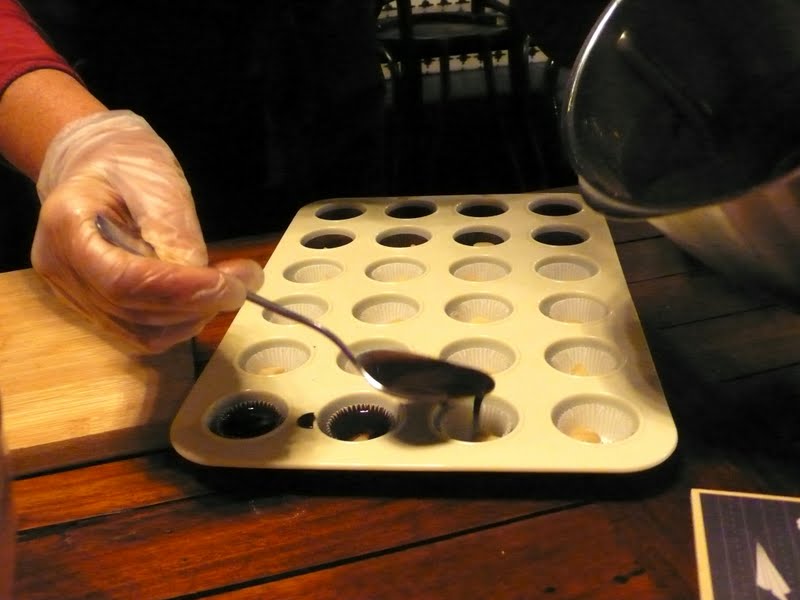
After making the cheesecake we learnt how to make some raw chocolate pastry for our ‘Pretty Little Raw Petti Fours’.


(Raw petti fours containing a filling made up of ground pepitas, sunflower seeds, honey, cinnamon and a little rosewater)


A petti four which tastes chocolately, sweet and all things nice but is packed with lots of nutrients so it’s totally guilt free. 


We then moved on to raw chocolate. Making raw chocolate was not originally on the menu as Hannah has a separate purely raw chocolate cooking class but when I emailed Hannah to register and told her that I was interesting in making raw chocolate, she took this into account and included in into our repertoire of desserts for the night.


The definite stand out of the night was the coconut macaroons made from a mixture of almond meal, vanilla seeds, shredded coconut, agave syrup and coconut oil. I guess they couldn’t be considered ‘real’ macaroons but they were really delicious so who cares really about the semantics? 


(The coconut macaroons reminded me of the Ferrero Raffaello chocolates with its mixture of almond and coconut)


When people choose to become vegetarian or raw, one thing they have to do is research about the foods they eat to ensure that they are eating enough specific types of foods to get the required vitamins, nutrients, minerals etc. in their diet now that meat is out of the equation. Throughout the class, Hannah was very generous in sharing the knowledge that she has gained over her years of reading about and consuming raw food. I found this information useful and enjoyed learning more about what was contained in the foods we eat and the nutritional components. While it’s a fact that when we cook foods it can diminish its nutritional value which is one of the main reasons for people going raw, there are some nutrients that we can only get from cooked food. For example, bread crusts contain the cancer preventing antioxidant pronyl-lysine which is not present in raw ingredients (read more about this on Hannah’s A Very Foodly Diary blog).  


The topic of conscious eating came up and was discussed in the class. And no this wasn’t the part of the class where people who aren’t raw get the whole guilt trip. A lot of people who go down the route of vegetarianism/raw food do so as a conscious decision. But it was acknowledged that food consciousness is not just about what you eat, but how you go about eating food too. 


Food isn’t just about subsistence, it’s also a lifestyle, a social activity and it’s a way of sharing and caring. Eating consciously can also extend to how we cook our food (the time and love spent on it), the circumstances in which we consume food (think weddings, parties, anything…the hours your mother has spent over the stove cooking dinner for those all important family get togethers), our appreciation of it and where we source our food from whether you are an omnivore, vegetarian or raw. I recently became a member of Slow Food Perth and a part of the movement’s philosophy is promoting alternatives to fast food, preserving and promoting local and traditional food products and cuisines, and encouraging ethical buying.  As I get more into cooking, I have definitely started thinking more about and being more aware of where my food comes from and try to buy more free range, organic foods, supporting local producers and buying from farmers’ markets. Also, I like to use fresh ingredients and cook things from scratch. Even though there are heaps of pre-made stocks and sauces readily available, they contain addictives and preservatives to get them onto the shelves and I don’t think that it’s a good idea to eat so much processed food. In my day-to-day life I practice mindful eating as much as I can. 


I enjoyed my decadent desserts cooking class. It had everything that I wanted from a cooking class – I learnt something, I got to cook and eat a lot of delicious food, and most importantly I had fun. I learnt that flavour does not have to be sacrificed just because you don’t heat food while cooking. A lot of the desserts we made involved combining together various nuts and seeds with natural fruit sweeteners which made for a lot of tasty combinations.


If you are interested in taking A Foodly Affair uncooking class, check http://afoodlyaffair.com/ and also read Hannah’s blog for her delicious raw food recipes.


p.s. When we first entered the class we were asked to write our name on a tag and also decorate the tag. The best decorated name tag would get a prize. I was picked as the winner and I received a little jar of coconut cashew cream! I am looking forward to using this one day to make some decadent raw treats for my friends. What did I do to win this jar of cream?... well I’ll let you in on one thing, I drew little ice creams for the construction of my name. Anyone who knows me well knows that I love ice-cream to the point that one day I ran down the road for about a mile after an ice-cream truck. I was gone for about 20 minutes and when I got back to my friends everyone was conjuring up stories of how I had eloped with the ice cream man and was having ice cream babies. Even though I didn’t get any ice cream that day, this inspired two of my friends to write a short story about this incident for a zine. Look out for stories that I have inspired about running after ice cream vans in the next edition of the zine I Am Still in Yesterday’s Clothes – Theme: Transit.

Wednesday, June 1, 2011

Potato and Leek Soup


How good is a hot bowl of soup in winter? 


French cuisine has generated many of the soups we know today. A characteristic of French soups is the use a of few fresh ingredients to produce a soup that generally has a rich and creamy consistency such as pumpkin soup, broccoli soup, asparagus soup, mushroom soup, potato and leek soup etc. Soups which I am sure that most of us have cooked at one point or another – simmer vegetables with some stock until soft enough to blend and hey presto you have soup! Just make sure that you let the mixture cool down a bit before blitzing in your blender or you could end up with more work than you bargained for, and soup all over your kitchen counter rather than in your tummy as hot liquid, vibration and stem blows the lid off. 


The origin of the word soup was from the old French word soupe. Soupe was a piece of bread soaked in a liquid or over which a liquid had been poured. The bread was a means for the diner to consume the liquid efficiently by sopping it up, the bread was in effect, an alternative to using a spoon. I think this explains why French onion soup is such a classic and famous French dish with its signature slices of toasted baguette covering the top of the soup to absorb the liquid. It epitomizes what a soup was originally meant to be… in the dark ages before thickening agents were used. Before bread was invented the only kind of thick soup was a concoction of grains, or of plants and meat cooked in a pot resulting in gruel or porridge like consistency. There are now many types of thick soups categorized by the type of thickening used - 
• Puree soups are vegetable soups thickened with the starch contained in the pureed vegetables. 
• Bisques soups are made from pureed shellfish thickened with cream.
• Cream soups are thickened with béchamel sauce or a roux, enriched with milk or cream.
• Veloute soups are thickened with eggs, butter and cream.


I’ve kicked off winter with a classic French soup - the simple but humble potato and leek soup which shows that less is more, with just a few ingredients you can create a rich and satisfying soup.


I found this recipe for potato and leek soup in the cookbook French by Damien Pignolet. Daimen reveals that the secret to this soup lies in the initial ‘sweating’ of the leeks and onions. This involves very slow cooking with a little butter in a covered pot, to release the vegetable juices. 


Potato and Leek Soup


(Recipe adapted slightly from French by Damien Pignolet)


Ingredients


• 3 large leeks, white part only
• 60g unsalted butter
• 1 small white onion, finely sliced
• 1-2 cloves garlic, finely chopped
• 1.5 litres light chicken stock or water
• 3 large Pontiac or other ‘old’ potatoes (~600-650g), chopped into small cubes)
• salt and freshly ground white pepper
• touch of freshly ground nutmeg
• ¼ bunch chives, finely chopped for garnish
• thickened cream to serve


Method


Trim the leeks just above the root and wash thoroughly, checking between the layers for any trapped grit. Cut in half lengthwise and wash again, if necessary, and slice thinly. Slowly melt the butter in a heavy-based 4 litre saucepan, add the leek, garlic and onion and coat with the butter. Cover the pan and sweat really slowly until they are very soft. On no account should they brown, so stir frequently. This will take up to 20 minutes. 


Add the cold stock and the potatoes, season lightly with salt and pepper, and bring to the boil. Skim the surface and allow to simmer for 20 minutes or until the potatoes are tender. Taste and adjust the seasoning – just a hint of nutmeg makes a big difference. 


(ladle of soup, pre-blending)


Allow the soup to cool for 15 minutes before pureeing with a blender to produce a smooth texture. If the soup becomes too thick you can add in some more stock.


Serve the soup with a swirl of thickened cream on top and sprinkling of chives. The chives tend to overwhelm, so use only a teaspoon per serving. 


You can add a little crème fraiche or double cream to turn this into a crème soup but I choose not to add any cream as I liked this soup just the way it was.


To make croutons


Remove the crusts from day old white bread and cut into 1.5-2cm cubes. Drizzle some olive oil over the pieces of bread and toss until the bread is evenly coated. Toast the bread in the oven for around 10 minutes or until crisp. Remove croutons from oven and set aside. 


Here are some of my other soup recipes