Wednesday, August 11, 2010

Japan #5 – Best meal in Japan at Okada, Chicken, Ocean and Mountain

Update 8 March 2013: Chika informed me that her sister has a website for her restaurant  which you can check out at http://www.okada-izakaya.com/ (it's in Japanese). 

Karen’s Japanese friend Chika has a sister who is a chef. We had dinner at her restaurant in Osaka and ate the most amazing meal of our trip!


Chika’s sister had one year training at a cooking school and then took up an apprenticeship at a prestigious Japanese restaurant where you were required to make a reservation in order to get a table and lunch would cost at least 10,000 yen (over $100 in Australian dollars). At this restaurant she met her husband and they opened their own restaurant together.


Located in Osaka, the restaurant is called ‘Okada, Tori, Umi, Yamano-sachi’. I asked what this meant and in English it translates into the Okada, Chicken, Ocean and Mountain restaurant. It’s pretty self-explanatory - Okada is the family name and the restaurant specializes in a chicken dish, all fish come from the ocean and all vegetables come from the mountains.


The restaurant has traditional style Japanese dining where you are required to take off your shoes and sit at low tables on cushions.


Japan as an island nation and its coastal waters support a variety of fish. It is one of the world’s greatest consumers of seafood. At this meal I consumed a number of fish that I have never eaten before.


We were served an elaborate 10 dish meal!


Fried eggplant which had been boiled and seasoned with dried shrimp.


Bonito fish with fried garlic and vegetables such as onion and daikon.
(Piece of bonito fish)

Croquette cake which is a French inspired dish with a bready crust and a crème filling that contained little bits of seafood.


A very hearty and warming lotus root and daikon soup (this soup was amazing…soooo good!)


Fried tile fish with bones removed.


Horse mackerel fish.


Octopus salad.


Bream fish in a rice soup served with a dish of pickled vegetables.


Baked chicken with a dressing made from sudachi (a Japanese citrus fruit) with a side of fried thinly cut potato crisps. 


I asked what sudachi was and the chef brought me out a little saucer of grated sudachi to taste and it was quite pungent, it has a much more zestier flavour and aroma than lemons or limes. 


Desert - Japanese squid rice flour balls topped with some bean paste and a maple leaf (no it’s not a marijuana leaf).


Of course no Japanese meal would be complete without some green tea served at the end of the meal.


Please note that the only way to eat such a feast is to have it spoon fed to you by a cute Japanese girl.
The cute girl on the left is Chika’s niece/the chef’s daughter and the big baby on the right is moi!


Because Chika’s sister was the chef, I was able to get a bit of a chef’s insight and she was very generous in telling me about what was in the dishes cooked. 


Salarymen sat at the table next to us and they ate a very elaborate meal presented on a wooden boat.


To this day, this was the best meal that we had in Japan (in my opinion). Everything tasted amazing, it encompassed everything Japanese food is about – the use of fresh seasonal ingredients, simply cooked with light and delicate, subtle flavours which are beautifully presented. 


Unlike Chinese, Vietnamese or Thai food, Japanese is not characterized by spiciness, richness or complexity of flavour - Japanese food stands apart from all other Asian food because of its simplicity and purity.


No wonder the Japanese have one of the most healthiest diets in the world!


If you are ever in Osaka, I highly recommend having a meal at -


‘Okada, Tori, Umi, Yamano-sachi’
5-13-2 Fukushima
Fukushima-ku Osaka-shi


Japan #4 – Guesthouse Yougendo

Staying in a traditional Japanese guesthouse is an awesome experience and I highly recommend it to anyone who is traveling to Japan.


For the first part of our trip we stayed at Guesthouse Yougendo situated in the middle of Nara and Osaka, right next to JR Oji station. It’s a 100 year old traditional Japanese house that has been converted into a guesthouse. We got to enjoy traditional Japanese living in Japanese style rooms with sliding doors and slept on futons on tatami floors. Japanese living spaces are small and with three futons on the floor, there wasn’t much space for anything else. During the day the futons were rolled up and stored in the closet. 


The fascinating thing about traditional Japanese houses is that the structure is composed on wooden columns and crossbeams which are intricately interlocked without the use of nails!


Japanese Garden


The Dining Room

Included in the accommodation was traditional Japanese style breakfasts.

‘Okayu’ Japanese rice porridge with toppings, generally a variety of pickled vegetables
Grilled "Eringi" Mushroom Omelette with rice and miso soup


Yougendo is a high-standard budget accommodation, for more information, visit their website http://www.yougendo.com/

Monday, August 9, 2010

Japan #3 – Only in Japan

SUPER MILLION HAIR! 


BACK SEATER
Plant on the back of scooter


SMOKING MAKE YOU STRONG
Cigarettes will turn you into Mr Muscle


ADVANCED TOILETS 
Toilet control pad


FERRIS WHEEL
Ferris wheel right in the middle of the city.


SUPER ORIGINAL STORE
…If you can feel what we are feeling then it’s a street fashion masterpiece…


TWO STOREY PARKING
Innovative parking solutions for 128 million people


BOOBIES TATOOS
Chopper spirit fuckin’ company


PARTY SPACE FELLOWS
Ooh lala

DOG CAFE
A dog café with some sweet treats for your best friend.

Friday, August 6, 2010

Japan #2 – Nara temples and local cuisine.

DAY TWO IN JAPAN
In Japan we did the touristy thing of visiting a lot of temples.  It’s interesting to note that when people travel to Europe, the thing to do it check out all the old churches and in an Asian country the thing to do is to check out all the old temples (for non-religious reasons). I guess it’s the history surrounding these buildings, the amazing designs/architecture and the influence on the culture of the society.   


Nara is an ancient capital of Japan and the birthplace of Japan. It has some of Japan's oldest and largest temples which are World Heritage listed. 


Today was temple bouncing day, we visited – 

  • the Horyuji Temple, which has great historical importance as it was from here that Buddhism blossomed and spread throughout Japan (it was selected as Japan's first World Heritage Site, designated in 1993); and
  • the Todaiji Temple, which houses Japan’s largest bronze Buddha statue and the world’s largest wooden building, even though the present reconstruction of it in 1692 is only two thirds of the original temple's size. Deers roam the grounds freely and are considered divine and sacred.


Karen’s Japanese friend, Chika, joined us for the day to guide us around Nara. On the train to Nara an old man started talking to us, he spoke good English and enquired about where we were from and where we were going. We told him we were going to the Horyuji Temple and he told us not to worry, he would take us there. When we got off the train, he led us to Horyuji Temple by taking the short cut and walking us through many small streets. He turned out to be a retiree and spends his spare time volunteering as a tourist guide for foreigners (ie: pouncing on unsuspecting victims on trains). 
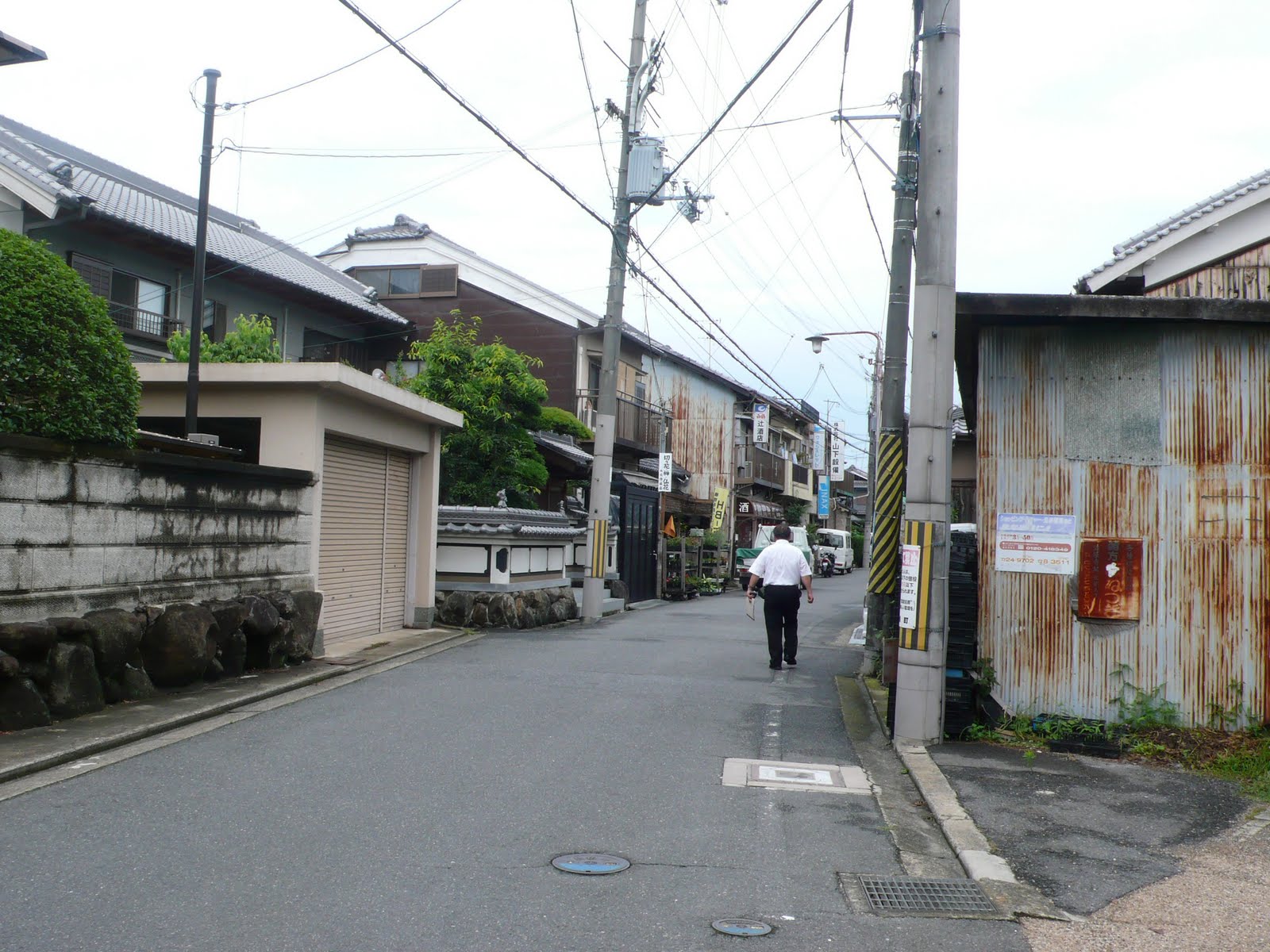
The benefit of having this old dude guide us around was that we got to see many of the local houses as we walked through the back streets and without him we would have stuck to the main roads. 
Private garden which grows eggplant!


I tried the local specialty of Nara which was kakinohazushi - sushi wrapped in persimmon leaves. The persimmon leafs have antibacterial properties and they are salted to increase the effect. All ingredients (mackerel, salmon, trout) are cured and placed inside a square wooden mold with the sushi rice on the bottom and pressed. The resulting block of sushi is then cut into individual bite sizes (rectangular blocks) and then wrapped with the salt cured persimmon leafs. After this is completed, they are once again placed neatly inside the mold and topped with a weight and left alone in a cool area for a few days. 
I was very excited about eating my very first piece of sushi in Japan. When the kakinohazushi arrived at our table I immediately picked it up and took a bite. Chika let out an exclamation in my direction and said that’s not how I’m supposed to eat it! I spat out the piece of sushi. I can confirm that the persimmon leaf is not edible. Chika told me that I was supposed to unwrapped the sushi from the leaf and then eat it…but I'm a tourist...I don’t know these things!
The Japanese are apologetic people and Chika kept on bowing her head to me and apologizing for not informing me of how to eat the sushi and I kept telling her that it wasn’t her fault, it was my fault. The next few minutes were spent apologizing. I kept apologizing for being an idiot and Chika kept apologizing for not stopping me from being an idiot....


But I have learnt my lesson now - persimmon leafs are not for consumption and should be discarded before eating!
I also had a bowl of green tea soba noodles.
I took photos of everything we ate, Karen described me to her Japanese friend, Chika, in Japanese as a ‘food maniac’ – I am guilty as charged!


Horyuji Temple
Todaiji Temple
Deers roaming free around Todaiji Temple.


A popular attraction of Todaiji is a pillar inside the temple which has a hole in its base the same size as the Daibutsu's (the Large Buddha's) nostril. It is said that those who can squeeze through this opening will be granted enlightenment in their next reincarnation.


FAIL!
SUCCESS!
With a little help...