Showing posts with label Japanese. Show all posts

Thursday, July 12, 2012

Mushroom and Rocket Sushi. Vegetarianism.


I am a minority meat eater.

About 75% of my close group of friends who I have known for 7+ years are vegetarian.
No, they are not hippies, but they are left and indie, which seems to have a high correlation with vegetarianism. In such circumstances, there would have been a high probability that I could have turned vegetarian too at some point in my life. However, my dad is a chef and I have been exposed to many amazing dishes throughout my life and so many memories of family feasts involve meat – a whole steamed fish, a whole roast duck or master stock poached chicken and on special occasions we would hack into a whole suckling pig. The Chinese have this thing where they like to serve the whole beast on the table as it is considered auspicious to have a beginning and an end, symbolizing abundance and togetherness. I enjoy eating meat and would find it very hard to give it up, and my family may disown me if I do. 

A whole chicken and whole fish - food my family eats for Chinese New Year.

It would not be unusual for me to be dining out at an Indian restaurant with a group of 10 people and be the only meat eater. But I have never restricted myself when ordering around my vegetarian friends, whilst they ponder over all the vegetarian curries on offer to order to share, I would order a plate of lamb chops all to myself. So one good thing is that I never have to share my food but I get to try a bit of everything else's dishes. While I tend to go for a meat option when dining out, when we have pot luck dinners or picnics I have cook food that is vegetarian friendly.

It always surprises people when I tell them that most of my friends are vegetarians, especially other food bloggers, some tell me that they wouldn’t be able to stand it. It’s common to find food bloggers taking a jibe at vegetarians in blog posts with statements like “vegetarians looks away, here's a picture of meat”, “feel sorry for vegetarians because they can’t eat here” or “I’ve ordered a token vegetarian dish”. It’s no secret that a general disdain is exhibited towards vegetarians because being vegetarian limits the food experiences you can have and vegetarian food is often viewed as bland or inferior.

Being vegetarian is almost like telling people that you are a non-drinker. You become subject to sneering remarks and people become condescending, telling you that you are missing out or you need to loosen up a bit and have some fun. No you are not better than everyone else just because you eat bacon or you like to have a beer or two. In the end it’s about choice. If vegetarians wanted to eat meat than they could but it doesn’t appeal to them, just as alcohol does not appeal to some people.

I have been exposed to a lot of different vegetarian dishes through my friends who have shown me time and time again that vegetarian food can be delicious. Without meat as the main source of protein, vegetarians are creative in cooking a variety of proteins (nuts, seeds, pulses and grains) and using different spices and seasonings to flavour dishes. I’ve found that vegetarian food is anything but boring. The only boring vegetarian food will be found at restaurants which provide one or two vegetarian dishes out of tokenism rather than offering a genuine choice. You can tell that not much thought has been put in when the only choices available are risotto or pasta (neither are particularly done well) or a medley of vegetables (ie: I stacked every vegetable I could find in the kitchen). I also have to be a bit more creative and think about what I cook for my friends. I like this challenge. One thing that I don’t think many people realise is that vegetarians also love food and they want to be excited by food and eat interesting dishes as much as meat eaters.

I coexist happily with my vegetarian friends, we often joke about it. The fact of the matter is that all vegetarians need to keep company with a meat eating friend, just as it’s a good idea for drinkers to have a non-drinking friend who can be the designated driver and actually recall details of the night before.

Case in point.

Last year my friends and I went down south to Margaret River. We had a rest stop at a petrol station/lunch bar off the highway on the drive down. We replenished ourselves with food at the lunch bar, it wasn’t anything great, but you can’t expect much from lunch bar connected to a petrol station off a highway with nothing else around. A lot of meat pies which have been sitting in the pie warmer for god knows how long, chiko rolls, dim sims, toasted sandwiches, chips, wedges and I admit to having chicken wingdings (trying to relive a childhood memory that was not worth going there for). While we were sitting down and eating our food a lot of bogan like people came in and out of the lunch bar. It was the major highway heading down south so the day-to-day clientele were truckies, hi-vis wearing tradies, other holidayers coming in to grab a Mrs Mac’s to go. We dubbed it bogan central. I was the only meat eater in the group and my friend commented that “it’s a good thing you’re eating meat, otherwise we might get bashed up”. This was a joke of course, but people perceive you differently and look at you funny sometimes when they know you are vegetarian. I knew my wingdings would save the day somehow, even though nothing could save its taste. To all the bogans entering the joint we were sending them telepathic messages…. “There’s meat on our table, we are not weird.”

***

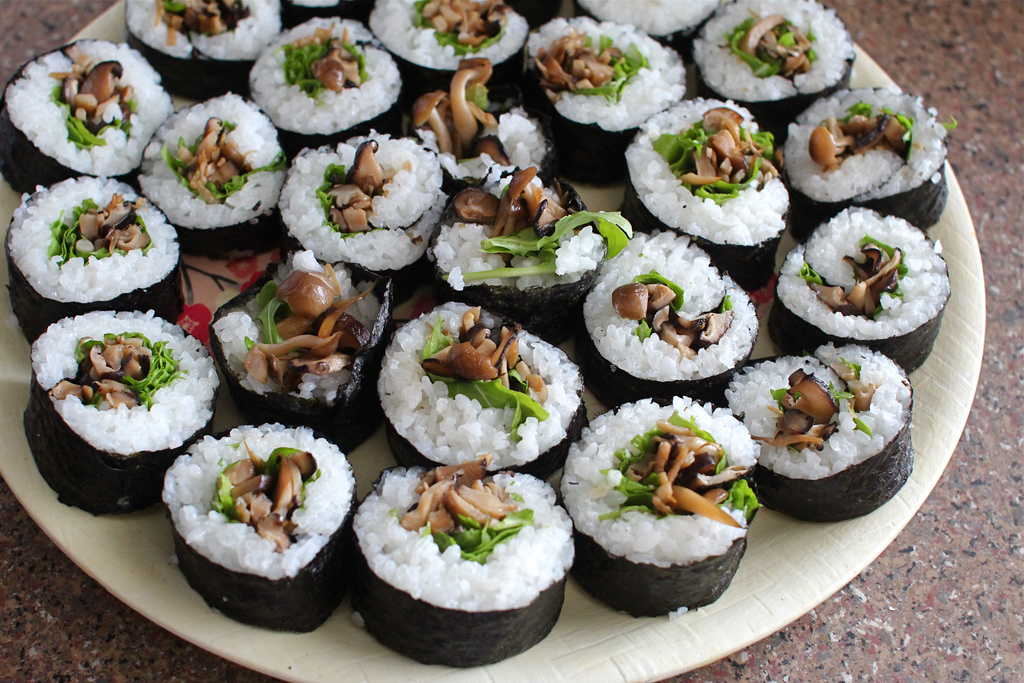
For a picnic, I came up with an idea to make some vegetarian sushi inspired by a lunch that I had at Aisuru Sushi where my friends were overjoyed by the fact that there was a full vegetarian and vegan menu, not just the token 2-3 items that they usually have to deal with. The mushroom sushi dishes were a favourite so I thought I would create my own version of mushroom sushi for my friends. 

So here’s my take on a mushroom sushi, bursting with 5 different types of mushrooms with a lot of depth in the flavour as a result of simmering the mushrooms in a dashi-soy broth until the liquid had evaporated into the pores of the mushrooms. 


Mushroom and Rocket Sushi

(An original recipe by the Blue Apocalypse, inspired by lunch at Aisuri Sushi and dedicated to my vegetarian friends)

Ingredients

•    2 cups sushi rice
•    rice vinegar mixture for sushi rice (2 tablespoons rice vinegar, 1 ½ tablespoons sugar and 1 teaspoon salt)
•    ~ 400g of mushrooms sliced into strips (mix of enoki, oyster, hon-shimeji, fresh shiitake)
•    rocket leaves
•    nori sheets
Mushroom dashi-soy broth
•    4 cups water
•    ~ 10cmX15cm piece kombu (dried kelp)
•    6 dried shiitake mushrooms
•    1-2 slices of ginger
•    3 tablespoons soy sauce
•    1 tablespoon sake
•    1 tablespoon mirin
•    1 teaspoon sugar
•    pinch salt

Method

Prepare mushroom dashi soy broth

Using scissors, make a few snips into the kombu to help release the flavours. Place water, kombu and shiitake mushrooms in a saucepan and soak for at least 30 minutes (the kombu and mushrooms will soften and expand).

Add ginger into the saucepan, place the pan over medium heat and slowly bring to the boil. Just before it reaches boiling point, remove the kombu and discard. Simmer the shiitake mushrooms for a further 5 minutes then remove the shiitake mushrooms and slice.

Add in soy sauce, sake, mirin, sugar and salt to taste.


Cook mushrooms

Heat up a large frying pan and add the mix of mushrooms (enoki, oyster, hon-shimeji, fresh shiitake mushrooms and rehydrated sliced shiitake mushrooms that was cooked in the dashi broth). Fry the mushrooms for a few minutes until they have browned slightly and reduced in volume.

Then add in a cup of the mushroom dashi soy broth and continue to simmer until the liquid has evaporated.

[Freeze the rest of the dashi soy broth for later use – you can make a soup with it]

Add mushrooms
Fry mushrooms
Add dashi stock
Simmer mushrooms until liquid evaporates

Cook and prepare sushi rice

Cook the rice according to the packet instructions OR Rinse the sushi rice repeatedly with cold water until the water is clear. Drain thoroughly.  Add the sushi rice into a rice cooker and add in 3 cups of water. Turn rice cooker on.

While the rice is cooking, prepare the rice vinegar mixture by heating the rice vinegar, sugar and salt in a small saucepan until the sugar has dissolved.

When the rice has finished cooking, remove it from the cooker and place it in a large bowl, drizzle the rice vinegar mixture evenly over the rice and thoroughly mix into the rice.

Let the sushi rice cool (you can fan it so that it cools faster)

Rolling mushroom and rocket sushi

Place nori sheet down on bamboo mat with the shiny side down and rough side up.
With wet hands, spread rice on the nori sheet, the layer of rice should be thin, less than ¼ inch thick.

Your hands should be wet when working with the sushi rice as it is sticky but keep hands dry when placing the nori on the bamboo mat and rolling it up.

Leave an inch of nori uncovered (the end furthest away from you) and rub a little of water on it (this will seal the two sides of the nori together).

Line up ingredients in the middle of the nori – place some rocket leaves on first and then add on top some cooked mushrooms.

Holding the closest edge of the bamboo mat, roll the sushi away from you, tightening the roll as you go. Keep the contents in the sushi roll tight and firm by using the bamboo mat to shape the roll, sliding it over and across the top of the sushi.

Run a knife under hot water to prevent it from sticking when it cuts the sushi pieces. Slice the sushi into ~ 2cm pieces.

Eat the mushroom and rocket sushi pieces dipped in a little soy sauce.


Related posts (other mushroom dishes you might like):

Tuesday, August 16, 2011

Onigiri (Japanese Rice Balls) and Miso Soup


Onigiri is a Japanese rice ball, often formed into a triangular shape and can be found in most convenience stores in Japan with various fillings and flavours.

(My 7-11 purchases in Japan)

When I travel, eating is one of the most important experiences – taking in the food culture of a country, trying out new foods not available at home, finding the best places to eat and eating authentic food (because nothing is more authentic than eating Japanese food in Japan, getting served by Japanese people and communicating your order in broken Japanglish). Traveling is also an excuse to eat more than your average three meals a day. But eating is amongst a whole bunch of other realities of traveling – figuring out the transport system, trying to take in as many of the sights and attractions the city has to offer, shopping (aka buying tacky souvenirs), conversing with the locals, avoiding scams/being assaulted and getting your bag snatched, sleeping, respecting the local culture/customs/etiquette, meeting other travellers, adjusting to different time zones every few days as you travel between cities… When you are traveling, sometimes you only have time for a quick snack in between getting up and hopping on your next train to your next destination (umm….temple #32).

Onigiri became a daily snack for me while I was traveling around Japan. I found it amazing how the onigiri was packaged with the nori stored separately from the rice so that the nori would remain crisp. It took some practice to know how to eat one properly.

See video here -

I have found that onigiri is quite easy to make at home and fun too when you realize that the rice is kind of like play dough and the possibilities for shaping your rice are endless.

Ingredients

•    cooked plain hot sushi rice
•    nori (seaweed)
•    Onigiri fillings (anything can be mixed into the rice as long as it’s not too moist or oily which will make the rice grains fall apart)
-    tuna (canned) seasoned with pepper and mixed with mayonnaise
-    white and black sesame seeds
-    furikake (Japanese mixed savoury flakes)


Method

I made two different type of onigiri. The onigiri needs made while the rice is hot so it will stick together and be easier to shape. 

Onigiri with furikake


I followed the instructions on the back of the furikake packet to make onigiri. I can't read Japanese but the pictures were pretty self explanatory. 


Transfer hot sushi rice into a bowl and add in some furikake. I didn’t know how much furikake to put in so I just added in a little at a time and mixed it all together, and tasted until I thought that the flavours were right. Make sure that you taste as you go and don’t add in too much in the one go as the furikake can make the onigiri quite salty. 


An easy way to shape onigiri which I learnt from the food blog Just Hungry is to use a small bowl/tea cup and plastic wrap.

Line the bowl with a piece of plastic wrap that’s big enough to hang well over the sides. Press the plastic wrap into the bowl.


Add some furikake rice mix into the bowl (the amount added depends on how big you want the balls to be). Gather up the ends of the plastic wrap and twist and squeeze, pushing out any excess air. Twist tightly to form a ball shape, pressing the rice grains to make them stick together.  


Untwist the plastic wrap and your onigiri is done! You can continue to reuse the plastic wrap for the rest of the rice.


Triangle shaped onigiri filled with tuna

Line the bowl with a piece of plastic wrap that’s big enough to hang well over the sides. Press the plastic wrap into the bowl.

Sprinkle the inside of the bowl with a little water and shake out the excess into the sink. Sprinkle the inside of the wetted, plastic lined bowl with a little salt and shake out any excess salt.

Fill the bowl with hot sushi rice. Poke a hole in the middle of the rice, about halfway down in depth. Add in some tuna and lightly press the rice over the filling. 


Gather up the ends of the plastic wrap and twist and squeeze, pushing out any excess air. 
To make the triangle shape, form a L shape with one hand and make three corners on the ball. Use the other hand to turn the ball and squeeze, turn, squeeze and turn until you get the desired triangle shape. 


Wrap the triangle onigiri with a piece of nori just as you are about to eat it so that the nori remains crisp.


When I was in Japan last year I bought a fish and car egg shaper. I have used it to shape boiled eggs with varying degrees of success, it’s quite difficult to get the egg to replicate the mould. 


I thought it would be cool to try using these moulds to make onigiri. 


This is how the fish turned out. I used some black sesame seeds for an eye and white sesame seeds for scales.

I don’t think that the car turned out as well as the fish as it was hard to get all the imprints.


To accompany the onigiri I made some miso soup.


Recipe for Miso Soup

Ingredients

Dashi Stock
•    3 cups water
•    10cm square piece kombu (dried kelp)
•    10-15g/3-4 T of katsuobushi (dried bonito flakes)
Miso Soup
•    2 tablespoon miso paste (mix of 1 ½ tablespoon white miso and ½ red miso or to taste)
•    ½ a block tofu, cut into 1.5cm cubes
•    5g dried wakame
•    finely chopped spring onion for garnish

Method

Dashi Stock

Using scissors, make a few snips into the kombu to help release the flavours. Place water and kombu in a saucepan and soak for at least 30 minutes (the kombu will soften and expand).

Place the pan over medium heat and slowly bring to the boil. Just before it reaches boiling point, remove the kombu and discard. Add the katsuobushi to the pot, boil for 30 seconds. Turn the heat off and let steep for 5 minutes.

Strain dashi stock through a fine sieve. Do not squeeze out the flakes, as this will make the stock cloudy and very fishy.

Miso Soup

Soak the wakame in cold water for 10 minutes. Drain and squeeze out excess water. Cut into bite-sized pieces.

Heat dashi stock in a pan and dissolve miso in a cup of the stock and pour back into remaining stock in the pan, making sure the stock does not boil after the miso is added (if the miso boils, the flavour will be altered).

Add tofu and wakame and heat through gently.

Serve the miso soup in a bowl, garnished with finely chopped spring onions.

You can read about my Japanese travel adventures and food endeavours here (under the Other tab)

Tuesday, November 16, 2010

Chawanmushi – Japanese Egg Custard

Chawanmushi is a Japanese savoury egg custard dish. Chawan means tea cup and mushi means steam, so it’s literally called “tea cup steam”. It consists of a delicate, stock-enriched egg custard mixture flavoured with soy sauce, dashi and mirin. Other ingredients are placed in the cup such as kamaboko, chestnuts, prawns, crab, chicken, ginko nuts and assorted vegetables like mushrooms, carrots and bamboo shoots. Even though the egg custard completely sets in steaming, the stock and juices released from the various other ingredients make the dish a little soupy. This dish is regarded as a soup in Japan and it is usually eaten as an appetizer.


I first had chawanmushi when we stayed at a Buddhist Temple in Mount Koysan.


Chawanmushi is easy and relatively quick to make, and it can be eaten hot or chilled. To make chawanmushi you need to make some dashi stock which is combined with egg to make a light custard that is steamed with various other ingredients. 


Dashi is essential to Japanese cooking, it provides the umami taste that is the foundation of Japanese cuisine. It is a clear, fish stock (generally made with kombu and bonito) used for soups, simmered dishes, salad dressings, and marinades. Dashi enhances all the flavours that surround it due to the kombu’s high levels of naturally occurring glutamate (think MSG). 


Basic Dashi Stock
6 cups water
approx 8cm square of kombu (dried seaweed/kelp)
3 tablespoons dried bonito flakes


Put kombu in pot and add cold water. Soak the kombu for 30 minutes (it will soften and expand).


Bring the water and the kombu almost to a boil over medium heat (this should take around 10 minutes). Just before the water comes to boil, remove the kombu and discard. Add the dried bonito flakes to the pot, boil for 30 seconds. Turn the heat off and let steep for 5 minutes. 


Strain the stock and allow to cool.


Note: Don’t boil the kombu as it will turn slimy, and the stock will be cloudy and bitter. The dashi stock will keep for two days in the refrigerator and can be frozen.


Chawanmushi
(This recipe yields 4-6 cups, depending on the size of the cups or bowls/ramekins)


4 eggs
2 ½ cup dashi stock
1 ½ teaspoon salt
1 tablespoon soy sauce (kikkomon brand)
1-2 tablespoons mirin or sake (to taste)
2-3 dried shiitake mushrooms, soaked and thinly sliced
4 prawns, shell/deveined and diced, and marinated with a little salt and sake
garnish with your choice of greens – mitsuba, watercress, coriander or spring onion


To make the custard - in a bowl, beat the eggs lightly with chopsticks (be careful not to aerate and whip in bubbles). In another bowl, mix room-temperature dashi, salt, mirin, and soy sauce (taste the stock before adding it to the egg and adjust the seasoning to desired taste). Pour stock mixture into beaten eggs. Mix well but do not beat (the surface of the mixture should be free of bubbles or foam). Strain the mixture through a fine sieve.


The seasoned stock mixture should be 3 times the volume of beaten egg, so apply this ratio of 3:1 in adjusting this recipe to the number of diners.


In each chawanmushi cup (or custard cup or ramekin) put in a few pieces of prawns and slices of shiitake mushrooms. Fill cups with custard mixture and skim off any bubbles that appear on top of the mixture, cover with a lid or foil. 


Preheat a steamer on high heat. Turn down the heat to low and place the cups in the steamer. Steam for about 15 minutes until the custard is just set. After 12 minutes, open the lids and add some greens to each cup, replace the covers and continue steaming for the remaining 3 minutes. 


The chawanmushi is done when a toothpick inserted in the center comes out clean. The custard should be set but still very soft and jiggle freely. It should have a silky, smooth texture similar to that of soft tofu.


Note: The chawanmushi needs to be steamed on a low heat because if the temperature is too high the egg protein coagulates leaving many tiny air pockets and the custard becomes tough. Also, do not overcook it and steam it for too long as the custard will be overdone and the top will be pocked and cracked, and loose its silkiness. 


Chawanmushi is so silky and light it literally melts in your mouth. The custard is very flavourful and packed with umami from the dashi and shittake mushrooms, and as you consume it, you find little bits of prawn and shitake mushrooms.


I only added shittake mushrooms and prawns to my chawanmushi but feel free to change the fillings – you can add anything that will complement the taste of the savoury custard base. Provide little surprises and varying flavours for your diners to find at the bottom of the egg custard cup!


A good chawanmshi should have a subtle flavour so do not overload the cups with too many ingredients. I recommend the addition of just 2-3 other ingredients. The additions of other ingredients should fill the cups no more than one-third of the way.

Monday, September 13, 2010

Japanese Tofu Salad

I have never eaten tofu in a salad until I traveled to Japan. Tofu was not really something that I associated with a salad. I have eaten tofu fried, steamed and braised but never just as is, chopped up, and in a salad. 


Eating vegetables with soft pieces of tofu is quite refreshing.
Ingredients
Gourmet salad mix 
- baby spinach
- cos lettuce
- rocket
- fancy lettuce
- watercress
- snow pea sprouts
- cherry tomatoes
Soft-firm tofu, cut into bite-sized pieces
Garnish with roasted sesame seeds and dried seaweed (shredded nori)
Japanese style dressing
- 2 tablespoons soy sauce (kikkoman brand)
- 1 ½ teaspoon sugar
- 1 tablespoon mirin
- 1 teaspoon sake
- 2 teaspoons grated ginger
- 1 tablespoon apple vinegar
- 2 teaspoons sesame oil
- 1 tablespoon vegetable oil


Whisk together all the dressing ingredients in a bowl, taste and adjust the seasonings to desired taste. 
In making the dressing I tried to recall the tastes that I encountered in Japan and there were certain elements that needed to be evident in the mix – soy sauce, ginger and hints of sesame.


On a plate, arrange salad and place pieces of tofu on top. Spoon the dressing over the salad and tofu. Sprinkle over the top roasted sesame seeds and then place some dried seaweed on top. 
VERDICT – My friends who I went to Japan with couldn’t stop eating this salad because it reminded them of Japan.