Showing posts with label mushrooms. Show all posts

Thursday, August 9, 2012

Truffle Breakfast with Slow-Poached Egg


Truffles are becoming more popular and commonly known among the general public as a highly prized and sought after edible mushroom. No longer are they just a mysterious fungi that people get confused with the ones of the chocolate variety.

Well this appears to be the case in Perth, with Perth diners tucking into more truffles than diners in Melbourne and Sydney combined and a record number of people attended the recent Mundaring Truffle Festival.

Not everyone is a fan though. I’ve noticed a love-hate relationship with truffles. Some people love it and have an euphoria for them, while others don’t see it as anything special, and don’t understand why people would spend several thousand dollars per kilo on it. Don’t people have better things to spend their money on? Are truffles overrated? How can something that basically looks like a turd and is described by some as smelling like dirt, old socks and sex, also be considered one of the most amazing foods in the world with chefs gushing over it like it’s a baby? You will often hear the expression “you can never have too much truffle” get thrown around. Listening to people who love eating truffles talk about them can be like listening to someone who is in a drug induced state sometimes. Truffles are strangely alluring and can also be addictive. Similar to the drug market, truffles are scarce and attract high prices. A CBS News 60 Minutes report earlier this year exposed a black market for truffles, where they are being trafficked like drugs, stolen by thugs, and threatened by inferior imports from China (watch here).

What do you think of truffles? Are you a fan of them?

Put me unashamelessly in the truffle lover camp. I’m one of those people that finds the aroma of truffles intoxicating and I love how the addition of truffles can enhance and intensify the flavour of a dish.

My first taste of truffles this year was at Cantina in June where I ordered their special truffle breakfast which had cheesey toast, mushroom puree, slow cooked egg, walnuts and parsley. The dish was around $20 without truffles and $30 with a generous shaving of truffles on top. The addition of truffles to the dish brought it to another level and I couldn’t imagine having it without the truffles. 

(Photo of the Cantina breakfast that I took on my phone)

I bought a truffle at the Mundaring Truffles Festival and one of things I wanted to do with it was recreate the breakfast that I had at Cantina.

So here is my truffle breakfast, it’s not the same as Cantina’s but it has similar elements - Slice of bread with truffle butter that I got from the July Urban Locavore box, sautéed mushrooms, rocket, a slow poached egg and truffles shaved over the top.


This was the first time that I have cooked a slow-poached egg. I used a method that I read about in the Momofuku cookbook where eggs are cooked using a Japanese technique – onsen style. Onsen in Japanese means hotsprings which the public bathe in. Using this method, the eggs are slowly cooked in their shells in hot water at 62-64C for about 45 minutes, so they are essentially just soaking in a hot bath. The result is an egg which has a just set texture, almost jelly like.

It’s probably the simplest way to poach an egg to guarantee an outcome that will be soft, creamy and ooze over whatever you put it on top of, however, it’s a little time consuming and you have to watch the temperature carefully. The good thing is that you can slow-poach a few eggs at a time and keep some in the fridge for up to 24 hours and reheat in a bowl of hot water for a few minutes before consuming. 


I have a thermometer but not one that you can clip onto the side of your pot. So I had to come up with a way to prop up the thermometer so that I wouldn’t be stuck holding it for 45-50 minutes while the eggs cooked. First I tried a fork but it wasn’t very stable, then I found a bottle opener in my draw which I balanced on the handle of the pot and it was quite secure. So I have discovered a new kitchen innovation while making this dish and I think that my bottle opener will come in handy for other things in the future besides opening bottles.

When my friend saw what I had done, he told me that I was just like my mother. I was a bit confused by this statement at first but then realized that he must be referring to this.


Sometimes when I walk into the kitchen of my parents house I find my mum doing some random things like using a chilli sauce bottle to keep chicken simmering in master stock submerged. It’s genius right?

Slow-Poached Eggs

(Recipe adapted from Momofuku – I used large eggs instead of medium eggs so cooked them at a slightly higher temperature and for a longer time than specified in the recipe from the book)
  • Remove eggs from fridge 30-60 minutes before cooking so that they are at room temperature.
  • Fill a large pot with water and put it on the lowest setting on your stove so that you can maintain the lowest possible heat.
  • Use something (a cake rack or steamer rack) to keep the eggs from sitting on the bottom of the pot where it will be directly on the heat source and be exposed to the highest temperatures.
  • Use a thermometer to monitor the temperature in the pot, heat the water to between 62C - 64C degrees, add the eggs into the pot. Let them slowly cook for 45-50 minutes, checking the temperature regularly on the thermometer. If it’s too hot you can add cold water, ice cubes or turn off the heat for a bit and then back on again until the heat is reduced to the right temperature range.
  • To serve, gently crack open the egg and slowly slide out onto a small saucer or plate. Tip the dish to pour off and discard the loosest part of the white, then slide the egg onto whatever dish you want.
Notes:
  • When you first put the eggs in, you may need to increase the heat a bit as the addition of the eggs may drop the water’s temperature.
  • You can test the eggs by taking one out after 45 minutes of cooking and cracking it open to see how cooked it is, if it looks like it needs a bit more time, cook it for a few more minutes.
  • If planning on storing slow-poached eggs in the refrigerator, chill them in an ice-water bath first.
Here are some of my other truffle recipes:

Thursday, July 12, 2012

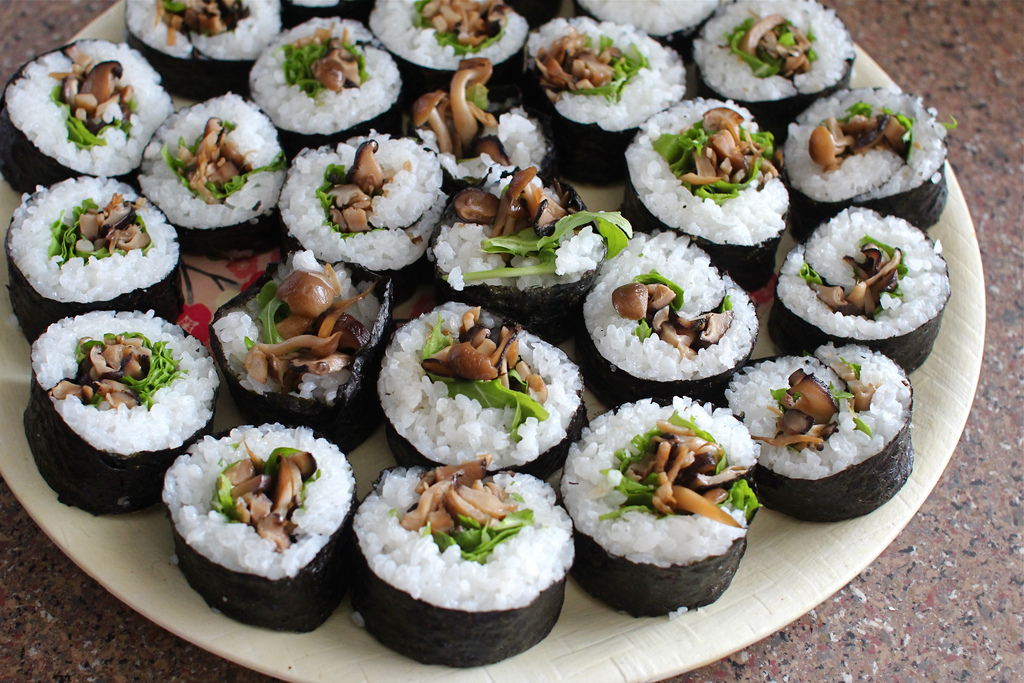
Mushroom and Rocket Sushi. Vegetarianism.


I am a minority meat eater.

About 75% of my close group of friends who I have known for 7+ years are vegetarian.
No, they are not hippies, but they are left and indie, which seems to have a high correlation with vegetarianism. In such circumstances, there would have been a high probability that I could have turned vegetarian too at some point in my life. However, my dad is a chef and I have been exposed to many amazing dishes throughout my life and so many memories of family feasts involve meat – a whole steamed fish, a whole roast duck or master stock poached chicken and on special occasions we would hack into a whole suckling pig. The Chinese have this thing where they like to serve the whole beast on the table as it is considered auspicious to have a beginning and an end, symbolizing abundance and togetherness. I enjoy eating meat and would find it very hard to give it up, and my family may disown me if I do. 

A whole chicken and whole fish - food my family eats for Chinese New Year.

It would not be unusual for me to be dining out at an Indian restaurant with a group of 10 people and be the only meat eater. But I have never restricted myself when ordering around my vegetarian friends, whilst they ponder over all the vegetarian curries on offer to order to share, I would order a plate of lamb chops all to myself. So one good thing is that I never have to share my food but I get to try a bit of everything else's dishes. While I tend to go for a meat option when dining out, when we have pot luck dinners or picnics I have cook food that is vegetarian friendly.

It always surprises people when I tell them that most of my friends are vegetarians, especially other food bloggers, some tell me that they wouldn’t be able to stand it. It’s common to find food bloggers taking a jibe at vegetarians in blog posts with statements like “vegetarians looks away, here's a picture of meat”, “feel sorry for vegetarians because they can’t eat here” or “I’ve ordered a token vegetarian dish”. It’s no secret that a general disdain is exhibited towards vegetarians because being vegetarian limits the food experiences you can have and vegetarian food is often viewed as bland or inferior.

Being vegetarian is almost like telling people that you are a non-drinker. You become subject to sneering remarks and people become condescending, telling you that you are missing out or you need to loosen up a bit and have some fun. No you are not better than everyone else just because you eat bacon or you like to have a beer or two. In the end it’s about choice. If vegetarians wanted to eat meat than they could but it doesn’t appeal to them, just as alcohol does not appeal to some people.

I have been exposed to a lot of different vegetarian dishes through my friends who have shown me time and time again that vegetarian food can be delicious. Without meat as the main source of protein, vegetarians are creative in cooking a variety of proteins (nuts, seeds, pulses and grains) and using different spices and seasonings to flavour dishes. I’ve found that vegetarian food is anything but boring. The only boring vegetarian food will be found at restaurants which provide one or two vegetarian dishes out of tokenism rather than offering a genuine choice. You can tell that not much thought has been put in when the only choices available are risotto or pasta (neither are particularly done well) or a medley of vegetables (ie: I stacked every vegetable I could find in the kitchen). I also have to be a bit more creative and think about what I cook for my friends. I like this challenge. One thing that I don’t think many people realise is that vegetarians also love food and they want to be excited by food and eat interesting dishes as much as meat eaters.

I coexist happily with my vegetarian friends, we often joke about it. The fact of the matter is that all vegetarians need to keep company with a meat eating friend, just as it’s a good idea for drinkers to have a non-drinking friend who can be the designated driver and actually recall details of the night before.

Case in point.

Last year my friends and I went down south to Margaret River. We had a rest stop at a petrol station/lunch bar off the highway on the drive down. We replenished ourselves with food at the lunch bar, it wasn’t anything great, but you can’t expect much from lunch bar connected to a petrol station off a highway with nothing else around. A lot of meat pies which have been sitting in the pie warmer for god knows how long, chiko rolls, dim sims, toasted sandwiches, chips, wedges and I admit to having chicken wingdings (trying to relive a childhood memory that was not worth going there for). While we were sitting down and eating our food a lot of bogan like people came in and out of the lunch bar. It was the major highway heading down south so the day-to-day clientele were truckies, hi-vis wearing tradies, other holidayers coming in to grab a Mrs Mac’s to go. We dubbed it bogan central. I was the only meat eater in the group and my friend commented that “it’s a good thing you’re eating meat, otherwise we might get bashed up”. This was a joke of course, but people perceive you differently and look at you funny sometimes when they know you are vegetarian. I knew my wingdings would save the day somehow, even though nothing could save its taste. To all the bogans entering the joint we were sending them telepathic messages…. “There’s meat on our table, we are not weird.”

***

For a picnic, I came up with an idea to make some vegetarian sushi inspired by a lunch that I had at Aisuru Sushi where my friends were overjoyed by the fact that there was a full vegetarian and vegan menu, not just the token 2-3 items that they usually have to deal with. The mushroom sushi dishes were a favourite so I thought I would create my own version of mushroom sushi for my friends. 

So here’s my take on a mushroom sushi, bursting with 5 different types of mushrooms with a lot of depth in the flavour as a result of simmering the mushrooms in a dashi-soy broth until the liquid had evaporated into the pores of the mushrooms. 


Mushroom and Rocket Sushi

(An original recipe by the Blue Apocalypse, inspired by lunch at Aisuri Sushi and dedicated to my vegetarian friends)

Ingredients

•    2 cups sushi rice
•    rice vinegar mixture for sushi rice (2 tablespoons rice vinegar, 1 ½ tablespoons sugar and 1 teaspoon salt)
•    ~ 400g of mushrooms sliced into strips (mix of enoki, oyster, hon-shimeji, fresh shiitake)
•    rocket leaves
•    nori sheets
Mushroom dashi-soy broth
•    4 cups water
•    ~ 10cmX15cm piece kombu (dried kelp)
•    6 dried shiitake mushrooms
•    1-2 slices of ginger
•    3 tablespoons soy sauce
•    1 tablespoon sake
•    1 tablespoon mirin
•    1 teaspoon sugar
•    pinch salt

Method

Prepare mushroom dashi soy broth

Using scissors, make a few snips into the kombu to help release the flavours. Place water, kombu and shiitake mushrooms in a saucepan and soak for at least 30 minutes (the kombu and mushrooms will soften and expand).

Add ginger into the saucepan, place the pan over medium heat and slowly bring to the boil. Just before it reaches boiling point, remove the kombu and discard. Simmer the shiitake mushrooms for a further 5 minutes then remove the shiitake mushrooms and slice.

Add in soy sauce, sake, mirin, sugar and salt to taste.


Cook mushrooms

Heat up a large frying pan and add the mix of mushrooms (enoki, oyster, hon-shimeji, fresh shiitake mushrooms and rehydrated sliced shiitake mushrooms that was cooked in the dashi broth). Fry the mushrooms for a few minutes until they have browned slightly and reduced in volume.

Then add in a cup of the mushroom dashi soy broth and continue to simmer until the liquid has evaporated.

[Freeze the rest of the dashi soy broth for later use – you can make a soup with it]

Add mushrooms
Fry mushrooms
Add dashi stock
Simmer mushrooms until liquid evaporates

Cook and prepare sushi rice

Cook the rice according to the packet instructions OR Rinse the sushi rice repeatedly with cold water until the water is clear. Drain thoroughly.  Add the sushi rice into a rice cooker and add in 3 cups of water. Turn rice cooker on.

While the rice is cooking, prepare the rice vinegar mixture by heating the rice vinegar, sugar and salt in a small saucepan until the sugar has dissolved.

When the rice has finished cooking, remove it from the cooker and place it in a large bowl, drizzle the rice vinegar mixture evenly over the rice and thoroughly mix into the rice.

Let the sushi rice cool (you can fan it so that it cools faster)

Rolling mushroom and rocket sushi

Place nori sheet down on bamboo mat with the shiny side down and rough side up.
With wet hands, spread rice on the nori sheet, the layer of rice should be thin, less than ¼ inch thick.

Your hands should be wet when working with the sushi rice as it is sticky but keep hands dry when placing the nori on the bamboo mat and rolling it up.

Leave an inch of nori uncovered (the end furthest away from you) and rub a little of water on it (this will seal the two sides of the nori together).

Line up ingredients in the middle of the nori – place some rocket leaves on first and then add on top some cooked mushrooms.

Holding the closest edge of the bamboo mat, roll the sushi away from you, tightening the roll as you go. Keep the contents in the sushi roll tight and firm by using the bamboo mat to shape the roll, sliding it over and across the top of the sushi.

Run a knife under hot water to prevent it from sticking when it cuts the sushi pieces. Slice the sushi into ~ 2cm pieces.

Eat the mushroom and rocket sushi pieces dipped in a little soy sauce.


Related posts (other mushroom dishes you might like):

Wednesday, March 7, 2012

Mushroom Apocalypse on a Desert

I get a lot apocalypse related keyword searches as a result of the name of my blog, so this year as we approach the ever impending doom of the Apocalypse that is predicted to occur on 21.12.2012, I will be on an endeavour to cook some apocalypse inspired posts.

Here’s my first apocalypse inspired dish - “Mushroom Apocalypse on a Desert”.


One of the predictions for the Apocalypse on 21.12.2012 is that there will be a galactic alignment, where the Sun will align with the center of the Milky Way galaxy for the first time in about 26,000 years. Some predict that this galactic alignment has the potential to create a shift in the Earth's poles and cause a series of catastrophic environmental events. In this scenario, we could be obliterated, everything is destroyed, it will be a dry and hostile environment like a desert (a common environment for post-apocalyptic movies, for example, Mad Max 2). Survival above ground will be difficult, the general solution will be to seek shelter underground. In fact, sales of bunkers have gone up after the Japanese earthquakes last year, business is booming in doomsday bunkers.

So for this dish I wanted to use the desert as a theme. Polenta was an ideal contender to be the desert as it resembles sand. But more importantly, polenta was originally and still is classified as peasant food, which will be the state that we will be reverted back to once the apocalypse occurs right? Polenta is easy to cook, has a long storage life, and is cheap and filling. It’s something that you would want to pack into your apocalypse survival kit as it will be relied on as a food staple as it always has been during times of hardship and struggle, like war, famine, tough economic times…


When thinking about what I could cook to put on top of the desert, one of the first things that came to mind were mushrooms for many reasons:

•    Foraging is all the rage at the moment and this trend will continue into the apocalypse as supermarkets will cease to operate and exist, so we will be hunting and gathering again like our ancestors did. You often see mushrooms out in the wild so it’s food that you can try foraging for in an apocalypse. But be careful because a lot of wild mushrooms are dangerous (deadly even) and not fit for human consumption. This also means that mushrooms can be used as a defense weapon by cooking the poisonous ones and feeding them to your enemies. Check out this link and commit to memory deadly looking fungi.

•    Mushrooms are easy to grow and do not require sunlight which is beneficial when you are living in an underground bunker in an apocalypse.

•    The golden rule for using mushrooms is to never wash them. That’s a bonus right? Because water will be scarce in an apocalypse. Mushrooms are extremely porous and soak up water like a sponge, if they are washed, it can spoil their texture, create too much moisture and impair their flavour. To prepare mushrooms for cooking, you can brush them with a small cleaning brush or wipe them carefully with a damp kitchen towel.

•    Mushrooms can solve any problems that arise when vegetarians and carnivores have to cook and eat together in an apocalypse. Mushrooms are considered meat for vegetarians – thick flesh with a meaty texture and savoury flavour, it will satisfy vegetable and meat eaters alike. 


I wasn’t always a fan of mushrooms, my first experiences of eating it was raw in salads and sandwiches, and I don’t think that mushrooms taste that good raw. No offence to raw foodists but food it meant to be thrown over a fire. Browning mushrooms causes the Maillard Reaction which develops and intensifies its flavour. When you eat mushrooms that have been cooked properly, they are a real treat.

There are hundreds of edible mushrooms and if you are going to be eating a lot of mushrooms, like I will be in the apocalypse, you want to know how to cook them a few different ways to keep things interesting. I tried to find as many different ways to cook mushrooms as I could and ended up with five different ways, including three methods that I have never tried before – deep frying mushrooms, confit mushrooms and cooking mushrooms en papillote.

 (Can you name all the mushroom in this photo?)
(soaking porcini)

Mushroom Apocalypse on a Desert


Polenta for the Desert

•    Soft polenta – Bring 3 cups of water and 1 teaspoon of salt to boil in a saucepan, add ½ cup of polenta in a constant stream with one hand and whisk vigorously with the other until the mixture starts to boil. Continue whisking for 2-3 minutes, then turn the heat down to a low simmer, stir the mixture more or less constantly for ~20-30 minutes until the polenta comes away from the sides of the saucepan, has a soft and creamy texture that is not runny or grainy. Add a tablespoon or more of butter and stir in until it melts.

Mushrooms cooked 5 ways (I used 7 different types of mushrooms)

•    Saute swiss brown mushrooms – Slice the swiss brown mushrooms. Melt butter in a frying pan, and sauté the mushrooms on a high heat until they have turned golden brown and the released juices have evaporated. (Note: “Don’t overcrowd the pan” – or the mushrooms will steam rather than brown)


(This is my favourite way of cooking mushrooms and how I usually cook them)

•    Deep fried enoki mushrooms – Heat 2 inches of peanut oil in a small saucepan and add in enoki mushrooms, in small batches at a time and deep fry until golden, this will be very quick and take around 10-20 seconds.


(I went out on a whim with this one. I decided to deep fry enoki mushrooms for texture, although I am not sure that I would do this again in the future as the spongey texture of mushrooms is not ideal deep frying material. It released a lot of water into the oil and splattered a lot, it was actually quite a dangerous experiment! I think this would work better if the mushrooms are covered in some tempura style batter before deep frying).

•    Roasted portobello mushrooms – Brush the tops of portobello mushrooms with a mixture of extra virgin olive oil, balsamic vinegar, salt and pepper. Place mushrooms on a baking tray lined with foil or greaseproof paper and roast for 15 minutes until they have browned.


•    Oyster, enoki and hon-shimeji mushrooms en papillote (baked in a bag) – Marinate mushrooms with a miso mixture (1/2 tablespoon white miso paste, ½ tablespoon mirin, 1 teaspoon soy sauce, 1 teaspoon honey, splash of extra virgin olive oil, pinch of salt and pepper). Split the mushrooms between pieces of greaseproof paper, top with thyme and scrunch into a parcel, secured with string (will look like a money bag). Place the parcels on a baking tray and cook at 180C in the oven until you see juices being released in the bag – about 12-15 minutes.

Marinated mushrooms
Mushroom parcel
 Mushrooms en papillote

•    Confit mushrooms (adapted from The Cook’s Companion by Stephanie Alexander) –

(Note: Why it is important to read a recipe before you make it! – I came across this recipe for mushroom confit from the Cook’s Companion and bought all the ingredients for it, then on the day that I had planned for apocalypse cooking I read the recipe and found out that you are required to seal and leave the mushroom confit for at least 2 months. I had not planned for this additional 2 months and when I tried the mixture after cooking it I found it really tasty so I decided to use it straight away, but I’m sure that it would have tasted much better after storing for 2 months. The recipe was slightly modified as a result with more olive oil added during the beginning of the cooking process, instead of pouring it over the top at the end)

Ingredients

•    1 head garlic
•    15g dried porcini mushroom
•    300g button mushrooms
•    1 bay leaf
•    1 sprig thyme
•    100ml extra virgin olive oil
•    freshly ground salt and black pepper
•    1/4 cup sherry vinegar

Method

Preheat oven to 180C. Wrap garlic head in oiled foil and bake in oven until tender (30-45 minutes).

Pour boiling water over the dried porcini mushrooms and leave to soak for 30 minutes. Lift the porcini mushrooms from soaking liquid and squeeze (strain the soaking liquid and freeze for later use in a soup or stew).

Place porcini, roasted garlic, button mushroom, thyme, bay leaf, and ½ oil in a baking dish which can also be used on top of stove (or in my case a pan that can be used in the oven). Grind some pepper over the top and cover tightly with foil. Roast for about 30 minutes until the mushrooms are tender.


Transfer baking dish/pan to top of stove and add sherry vinegar over medium-high heat, stirring to dislodge any stuck-on bits. Allow vinegar to bubble up and reduce. Remove garlic and peel the skin off. Discard thyme, bay leaves and garlic skins.

Put the garlic, mushrooms, all the juices and 1/4 of the leftover olive oil in a food processor and pulse to a coarse puree. Taste for seasoning, add in salt or pepper if desired.


Put the mushroom mixture into a jar and pour over the remaining ¼ of olive oil, use within 2 weeks.

I used the mushroom confit straight away but if you follow the recipe, ideally it should have been packed into a hot, sterilized jar and left for at least 2 months.

To serve: Use your imagination to plate up the polenta and mushrooms in your view of a mushroom apocalypse on a desert.


More mushroom recipes -

Monday, February 6, 2012

Soy Sauce Chow Mein (Stir Fried Egg Noodles)


Whenever my family went out for dinner at Chinese restaurants, this was the first dish that my parents would order for us kids to eat in order to shut us up, while we waited for other relatives to arrive or as my dad took his time to carefully consider the menu items and ordered. Once we were seated, my dad would get the waiter to immediately bring out a plate of soy sauce chow mein, this is a Cantonese dish and literally translates into “soy sauce king chow mein”, as the soy sauce is the star of this dish. It was a bit of a pre-dinner snack, pre the entrees (although we generally didn’t order entrées). Us kids would have this dish all to ourselves and eat it all up as we waited for the main dishes of the meal to arrive.

Did anyone else have a similar experience to me as a child? Did your parents order you a dish at a restaurant as a snack at the start of a meal before the mains would come?

Soy sauce chow mein is a dish that is really quick and easy to fry up at home but worth ordering at a restaurant. Chow mein ordered from restaurants always taste better than home cooked versions because restaurants have huge stovetops that enable these noodles to be fried quickly over high intensity flames, and gives the noodles ‘wok hei’, which is the smoky aromatics imparted by a hot wok on food during stir frying.

The key to getting these noodles right is to undercook the noodles a little in the first step when you are reconstituting them in boiling water, so that the noodles maintain a firm texture (take into account that you will further cook them in the wok). Have all your prep ready and work quickly. A tip that I learnt from my dad for cooking noodles so that they don’t break is to use chopsticks to stir fry and toss everything around, it works everytime, guaranteed to minimise noodle breakage! I either have a pair of chopsticks in each hand and frantically toss everything together, or have a pair of chopsticks in one hand and a spatula in the other, and use both utensils to incorporate everything. The chopsticks also allow me to get between the layers of ingredients and noodles, and mix everything together well.

I like to cook soy sauce chow mein when I want something quick, simple and tasty for dinner.


Soy Sauce Chow Mein 

Ingredients

For 2-3 serves
•    ~250g fresh thin egg noodles (you’ll find them in the refrigerated section of Asian supermarket)
•    5-6 dried shiitake mushrooms, rehydrated and sliced
•    bunch Chinese flat leaf garlic chives, cut into 4-5cm lengths
•    200-300g bean sprouts
•    salt
•    Shaoxing wine
•    roasted white sesame seeds

 (Fresh Egg Noodles from my local Asian supermarket)

Soy Sauce Mixture

This quantity of soy sauce is more than enough to cook the above serving. I always mix a bit more sauce than I need, so that I have some leeway when cooking to adjust the taste. Leftover sauce can be used to cook more noodles (you may need to mix some more if you are cooking a large quantity of noodles) or refrigerate the mixture and use for a stir fry.

•    1 tablespoon light soy sauce
•    2 tablespoon dark soy sauce
•    1 tablespoon oyster sauce
•    1 teaspoon of sugar to taste
•    pinch of salt and ground white pepper to taste
•    ½ teaspoon sesame oil
•    4-5 tablespoons of water to taste

[Note: For this dish to be completely vegetarian, you can omit the oyster sauce]

Method

Add the fresh egg noodles to a pot of boiling water and simmer until just cooked (check the packet instructions, cooking time is usually 1-2 minutes). Drain noodles in a colander and run them under cold water to stop the cooking process. Drain the noodles thoroughly until dry.

Mix together sauce ingredients in a bowl and set aside.


Before cooking with the wok, dry fry a tablespoon of white sesame seeds to colour and bring out their aroma. Remove and set aside.

(Toasting sesames seeds in wok)
 (Toasted sesame seeds)

Heat some oil in a wok, sauté garlic chives until fragrant, add in the bean sprouts, a pinch of salt and splash in some Shaoxing wine. Stir fry the garlic chives and bean sprouts together until the bean sprouts are cooked yet still crunchy (30-60 seconds). Remove and set aside in a colander to drain any water that leaches from the bean sprouts.

Heat some oil in a wok and sauté the shiitake mushrooms until browned. Then add in the egg noodles, toss and stir them around constantly to cook evenly (using chopsticks helps). Spoon in the soy sauce mixture, a tablespoon at a time, and stir well into the noodles, add as much soy sauce as desired (approx 5 tablespoons or more) and taste as you go (be quite liberal with the soy sauce as this is what makes these noodles taste good). Once you are satisfied with the flavour of the noodles, add in the garlic chives and beans sprouts to the wok and quickly toss altogether until combined.


 Serve with roasted sesame seeds sprinkled on top.